
How a preform becomes a bottle
Heating, stretching, blowing and cooling. Scroll through the 3D scene to see each stage, with typical blow moulder settings below.
How a preform becomes a bottle
Keep scrolling: a 21.7 g PCO 1881 preform is heated, stretched and blown into a 0.5 L bottle, as in the blow moulder on your line.
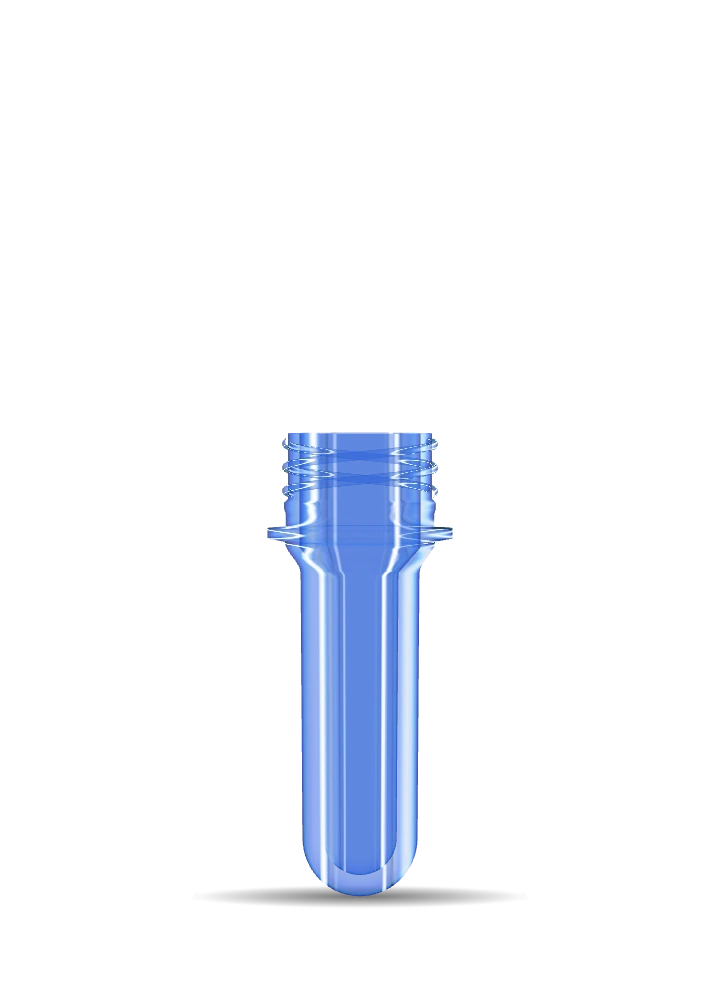
Preform
An injection-moulded blank with the finished neck: thread and support ring are final.
Heating
Infrared lamps heat the body to 100-110 °C. The neck stays cool so the thread keeps its shape.
Stretching
A stretch rod pulls the preform down to about three times its length.
Blowing
Air at up to 40 bar presses the wall against the mould, thinning it to a fraction of a millimetre.
Bottle
The mould cools the PET and the bottle is ready to fill. It weighs exactly as much as the preform.
Simplified diagram: settings depend on the blow moulder and the mould.
Typical settings
A guide to the process. Real settings depend on the blow moulder, the mould and the preform.
| Stage | Typical values | What it affects |
|---|---|---|
| Body heating | ≈95-110 °C | material distribution in the bottle |
| Neck cooling | the neck stays cool | thread shape and cap seal |
| Rod stretching | ≈2.5-3.5 times in length | gate centring and base thickness |
| Pre-blow | ≈5-12 bar | shoulder and wall shape |
| Main blow | up to ≈40 bar | sharpness of ribs and base |
| Mould cooling | fractions of a second | base stability and dimensions |
The two-stage process
Most bottling plants work in two stages: preforms are moulded by a supplier and bottles are blown on site right before filling. That avoids shipping empty bottles: one box carries thousands of preforms.
Stretching in two directions
The rod pulls the preform down while air blows it outwards. Multiplying the two stretch ratios shows how far the material was stretched. That orientation is what makes a thin bottle wall strong.
What affects bottle quality
- The heating profile across oven zones: warmer material gives a thinner wall.
- Even heating around the circumference: preforms rotate in the oven.
- Pre-blow timing and pressure.
- Preform temperature at the infeed: in winter a cold batch needs time in the shop.
- Consistency of the preforms themselves: weight, geometry and a clean gate.
